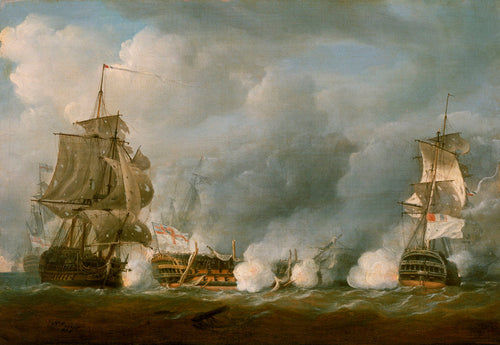
A small frigate closes on a towering Spanish warship. On paper, the encounter ought to be absurd: one ship carries barely a quarter of the other’s guns. Yet the larger vessel has already survived a battle, and her damaged rigging has made escape difficult. John Christian Schetky’s painting catches something that lists of naval armaments can obscure. A warship’s strength depended on what she could still do, not simply on what she carried.
The Spanish ship is Santísima Trinidad, whose fuller name was Nuestra Señora de la Santísima Trinidad. Launched in Havana in 1769, she served for more than three decades before her capture at Trafalgar and loss in the storm that followed. Her extraordinary size made her famous. Her history is more interesting than the superlative: a story of ambitious shipbuilding, repeated reconstruction, a narrow escape and a final battle fought at the centre of a collapsing fleet.
The artworks below, drawn from the Historical Maritime collection, follow that story. Some portray the ship herself; others show the battles in which she fought. Their dates matter: these are interpretations made after the events, and they reveal how naval history was remembered as well as how it happened.
Built In Havana: A Spanish Ship With International Origins
The ship’s beginnings lead away from European battlefields to the royal dockyard at Havana. The naval architect Mateo Mullan, an Irishman in Spanish service, proposed a great three-decker there in 1767. The project belonged to a period when Spain’s navy drew on foreign expertise while developing its own shipbuilding capacity. The boundaries between rival naval traditions were more permeable than a battle painting might suggest.
Mullan did not live to see the launch. After his death in November 1767, responsibility was divided: his son Ignacio handled the plans, while Pedro de Acosta oversaw construction and strengthening. The Museo Naval’s account of the related Real Carlos model explains this succession. It replaces the appealing idea of a single designer’s masterpiece with a more practical history of drawings, decisions and shared responsibility.
Spanish naval research dates the launch to 2 March 1769. José Manuel Serrano Álvarez’s study in the Revista de Historia Naval, no. 105, places the vessel within the administrative and financial work of the Havana arsenal. A ship of this scale was a major undertaking long before she fired a shot: timber had to be acquired, labour organised and the work sustained through changes in personnel.

Jacob Hägg’s 1913 etching offers a particularly effective way to begin looking at the vessel. The viewpoint is low and behind the ship. Her broad stern occupies the centre, while sails and rigging rise almost to the top of the sheet. The little vessel to the left provides a scale against which to judge her bulk.
There is no battle smoke here. The drama lies in the relationship between the carefully built ship and the irregular sea beneath her. Hägg distinguishes the ordered lines of galleries, spars and rigging from the broken surfaces of the waves. The effect is imposing, but also precarious: all that weight and complexity must be kept moving through water. As a later reconstruction, the etching is best read as a ship portrait, rather than an eyewitness record of a particular voyage.

Michael Zeno Diemer’s Ship at Sea offers a companion to Hägg’s monochrome portrait. The view is again from astern, but colour gives the vessel a different presence: warm red bands run along the hull, pale galleries curve across the stern, and broad sails catch the light above a deep green sea. A second ship, much smaller in the composition, helps us judge the scale of the nearer vessel.
Look at the contrast between the long, regular rows of stern windows and the broken crests of the foreground waves. Diemer makes the ship appear both intricately constructed and alive to the movement of the water. There is no smoke or visible combat to fix the scene to a named battle. It is better understood as a later vision of Trinidad at sea, inviting us to imagine her working life before the damage and surrender that dominate accounts of her final voyage.
Why Did Santísima Trinidad Have Four Gun Decks?
She began as a three-decker. The fourth tier that made her so recognisable belonged to a later rebuilding, usually dated to 1795–96. Joining the forecastle and quarterdeck created a continuous upper battery. It is therefore misleading to imagine that the ship left Havana in precisely the form in which she fought at Trafalgar.
The Academia de las Ciencias y las Artes Militares’ account distinguishes the original vessel from the enlarged ship after her major refit. Published gun totals vary: 130, 136 and 140 all occur in historical descriptions. The Three Decks register records a 136-gun armament for 1805, while other references use 140. These figures should not be silently treated as interchangeable measurements of a single, unchanging vessel.
A total also says little about the weight of each gun. A small weapon high in the ship did not deliver the same shot as a heavy piece on a lower deck. Nor could the whole armament normally be brought to bear on one enemy at once. The practical question was how many guns could fire from the engaged side, at the right angle, while their crews continued loading and serving them.
That distinction is essential to the rest of the story. Extra artillery increased the ship’s imposing appearance and potential firepower, but did not remove the need for manoeuvrability. The Spanish Ministry of Defence’s Trafalgar study describes persistent difficulties in her sailing qualities despite repeated alterations. A large warship could be both formidable and awkward to handle.
Before Nelson: Convoys And The War Around Gibraltar
Trafalgar tends to swallow the earlier lives of the ships that fought there. By 1805, however, Santísima Trinidad had already belonged to an older generation of naval warfare. She served as Luis de Córdova’s flagship during the war against Britain associated with American independence.
The exhibition catalogue La Memoria Recobrada records her service in the Channel, her participation in the capture of the great British convoy on 9 August 1780, and her involvement at Cape Spartel. These operations place her in a wider world than the familiar duel between Nelson and Napoleon: commerce, imperial communications and the struggle over Gibraltar were central concerns.
Convoy warfare could be less spectacular to paint than a close engagement between battleships, yet its purpose was immediate. Merchant vessels carried the supplies, people and resources that made distant operations possible. Capturing them attacked an enemy’s ability to sustain a war. A flagship’s contribution could thus be important without ending in a celebrated exchange of broadsides.
Cape St Vincent, 1797: The Great Ship Nearly Lost
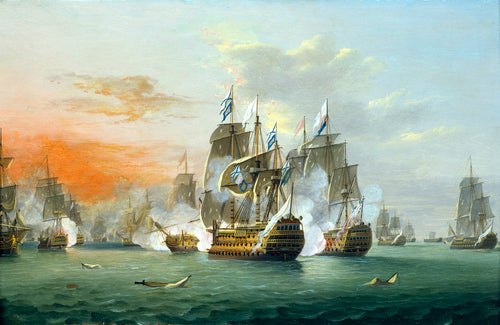
On 14 February 1797, Santísima Trinidad carried the flag of José de Córdoba in the battle off Cape St Vincent, near the south-western end of Portugal. The British commander was Sir John Jervis. Nelson, still a subordinate commander, was aboard the 74-gun Captain.
The battle turned on the British ability to keep separated parts of the Spanish fleet from combining. Nelson took Captain out of the British line and into action against the powerful ships near the Spanish centre. The study of Cape St Vincent in Forgotten Decisive Victories discusses this intervention as an example of independent action within a larger tactical purpose. Numbers mattered, but the immediate arrangement of the ships mattered more.

Thomas Luny’s painting of Victory and Salvador del Mundo makes the importance of position visible. The foreground vessels are close, their hulls partly obscured by bursts of white smoke. Further ships recede along the horizon, but the eye returns to the concentrated exchange nearest us. The composition turns a fleet action into a problem of angles and proximity.
“Raking” meant firing along an enemy vessel’s length, from ahead or astern, rather than simply into her side. It was a particularly dangerous position for the ship receiving the fire. Looking at Luny’s compressed foreground helps explain why a powerful battery alone could not guarantee safety: the direction from which an opponent approached could be decisive.
Trinidad was badly damaged and came close to being taken. Spanish relief, notably Pelayo under Cayetano Valdés and San Pablo under Baltasar Hidalgo de Cisneros, enabled her escape. The Revista General de Marina account of Valdés gives those ships their place in the story. The survival of the flagship was an achievement within a Spanish defeat, rather than evidence that the battle had somehow been won.

Daniel Orme presents the same battle through a very different kind of scene. Officers gather around the surrender of a sword; the fighting has become a formal encounter between recognisable people. Wounded figures remain at the edge of the ceremony. Their presence prevents the ordered central group from entirely concealing the violence that produced it.
The Royal Collection’s record of the related published print identifies the surrender as that aboard San José. This distinction matters when following Trinidad: Nelson’s famous boarding exploit and the escape of the Spanish flagship belong to the same battle, but they are separate episodes.
A Frigate Against A First Rate

Escaping a fleet action did not mean reaching safety. On 1 March 1797, the frigate Terpsichore, commanded by Richard Bowen, attacked the damaged Spanish ship. The encounter appears in the ship’s service chronology. Bowen could harass a wounded opponent, but he did not capture her.
Schetky makes the disparity immediately apparent. The Spanish stern rises in several tiers above the water. Beside it, the frigate looks low and lean. Yet the larger ship’s damaged sails and truncated rig emphasise what has been lost. A red-and-yellow ensign still flies above her; below, the guns answer through smoke.
Notice how much of the picture is given to sea and sky. The two ships occupy a relatively narrow band across the lower half, surrounded by moving water. They are close enough for the confrontation to be legible, but not locked together. Space remains between them, and that space is the subject: whether the smaller ship can stay in a useful position, and whether the larger can turn her strength against it.
The painting is particularly valuable alongside Hägg’s portrait. One asks us to admire the intact structure; the other shows how damage changes its meaning. A missing mast is not merely a broken vertical in a picturesque scene. It reduces the means by which the vessel can move, turn and choose the terms of an encounter.
Trafalgar: At The Centre Of The Battle
On 21 October 1805, Santísima Trinidad fought again, this time under Captain Francisco Javier de Uriarte y Borja, carrying the flag of Baltasar Hidalgo de Cisneros. She lay ahead of the French flagship Bucentaure. This placed her near the point towards which Nelson’s division advanced.
The British approached in two columns, led by Victory and Royal Sovereign, against a combined French and Spanish fleet. Collingwood’s dispatch describes the formation and the close fighting that followed. Breaking into the opposing line allowed British ships to concentrate on parts of it instead of conducting a single, even exchange along its whole length.
For Trinidad, the action became a sustained struggle against British opponents, including Neptune. Her masts were brought down and her ability to continue resistance deteriorated. She eventually surrendered. The Spanish account of the battle follows the damage, the failed effort to manoeuvre clear and the wounding of Cisneros. The ship survived the gunfire as a floating hull, but no longer as an effective fighting vessel.

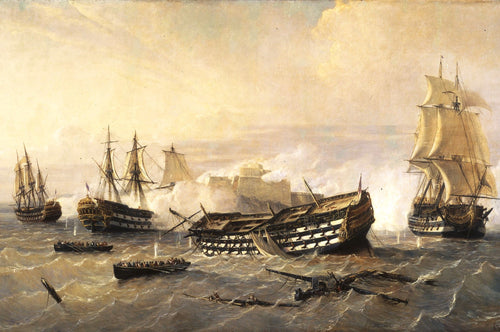
In Buttersworth’s painting, Royal Museums Greenwich identifies Trinidad in the left foreground and Bucentaure on the right. Between them, British ships enter the struggle. Fallen spars lie close to the viewer, carrying the destruction away from the distant hulls and into the open water before us.
The picture is unusually readable for such a crowded action. Pale smoke separates dark hulls; flags supply accents above the rigging; a broad opening in the middle draws the eye towards further ships. This clarity is an artistic achievement. It should not persuade us that an officer on deck could have surveyed the battle with the same ease. The painter gives us a view assembled for understanding, not the restricted sightline of a participant.
The Last Days: Why The Captured Ship Was Sunk
The battle did not end the danger. Damaged vessels had to be secured, prisoners and wounded men cared for, and ships with little remaining rig brought away from a hazardous coast. As the weather worsened, keeping a prize became a problem of survival as much as possession.
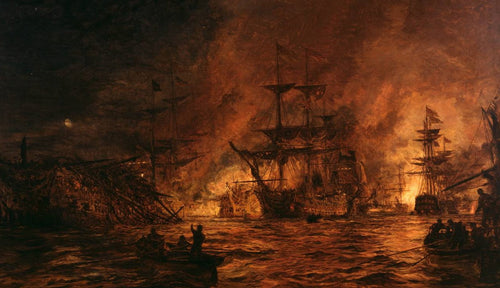
Collingwood’s dispatch of 24 October records broken tow ropes, drifting ships and his decision to destroy prizes that could be cleared of their men. He specifically reports that the captains of Prince and Neptune evacuated Trinidad and sank her. Royal Museums Greenwich dates the scuttling to 24 October 1805, on Collingwood’s orders. “Scuttled” means deliberately sunk: the final loss followed capture and the attempt to manage the wrecked fleet in worsening weather.
That sequence gives the story a different ending from a painting of a ship disappearing beneath a victorious broadside. There was an interval in which the vessel remained afloat and her future was undecided. Men who had been enemies had to deal with the consequences of the same storm. The prize that might have symbolised victory became a burden that could not be brought safely away.
Even early commemorative art compressed this history. A glass picture published in January 1806, now at Greenwich, places a sinking ship named as Trinidad behind an allegorical scene of Nelson’s death. The museum’s catalogue separates the image’s message from the chronology: Nelson died during the battle; the captured Spanish vessel was sunk afterwards. It is a small but revealing example of how quickly an event could become a legend.
Looking Beyond The Largest-Warship Legend
Santísima Trinidad is easy to remember as a number: four decks, more than a hundred guns, an immense wooden hull. The pictures encourage a longer look. Hägg gives her solidity and height; Diemer brings colour and movement to her passage through the sea. Schetky makes those qualities vulnerable. Luny shows how a fleet battle could turn on the angle between two ships, while Orme shows how victory was translated into a ceremony. Buttersworth gathers destruction into a scene that a later viewer can follow.
Read together, they allow the ship to become more than a spectacular casualty in Nelson’s story. She was the product of a Havana dockyard, the workplace of successive crews, a flagship in several wars and a vessel repeatedly altered in the hope of improving her usefulness. Her end at Trafalgar was dramatic. The long effort of building, repairing, sailing and preserving her is what gives that ending its weight.
For the wider campaign and the decisions behind the British attack, read our companion article, The Battle Of Trafalgar Explained: Tactics, Ships And The Storm.
Common Questions About Santísima Trinidad
Where Was Santísima Trinidad Built?
She was built at the royal dockyard in Havana, Cuba, for the Spanish navy and launched on 2 March 1769. Mateo Mullan began the design; Ignacio Mullan and Pedro de Acosta continued the project after his death.
Was She A Four-Decker From The Beginning?
No. She began as a three-decker. A major rebuilding in the 1790s created the continuous upper battery associated with her later four-deck appearance.
Was Santísima Trinidad Captured At Cape St Vincent?
She came close to capture in 1797, but Spanish ships intervened and she escaped. The surrender shown in Daniel Orme’s painting is that of San José, not Trinidad.
What Happened To Her After Trafalgar?
Captured on 21 October 1805, she was evacuated and scuttled during the aftermath. Royal Museums Greenwich gives the date of her loss as 24 October.
About The Sources And Illustrations
Historical references are linked alongside the relevant passages, including Spanish naval studies, museum collection records and Collingwood’s published dispatches. Gun totals vary between sources and periods of the ship’s service. Captions distinguish the dates of battles from the dates of the artworks, and identify scenes involving other ships. The illustrations use the main artwork images from the Historical Maritime print catalogue; readings of their composition are editorial interpretations.