An island that could sink beneath a boat. Arms that rose from the sea like masts. A creature powerful enough to drag a ship into the depths. The kraken occupies a remarkable place in maritime history: a monster whose changing image reveals how sailors, naturalists and artists tried to understand an ocean they could only partly observe.
Its history deserves more than a collection of frightening stories. The surviving accounts contain different kinds of evidence: descriptions of local beliefs, reports repeated at second hand, imaginative engravings and, eventually, preserved remains of enormous squid. Reading them together helps explain both the endurance of the legend and the limits of what it can tell us about real animals.
Two prints in the Historical Maritime collection provide striking points of departure: Pierre Dénys de Montfort’s Le Poulpe Colossal, listed in our collection as 1801, and The Kraken from John Gibson’s Monsters of the Sea: Legendary and Authentic (1887). Alongside them, two further nineteenth-century illustrations show the story moving towards specimens that could be examined.
Reading The Evidence
A historical account proves that a story was recorded; it does not, by itself, prove that the described event happened. Giant squid are real animals. The island-sized, ship-sinking kraken belongs to maritime folklore.
Northern Seas And Medieval Traditions
The kraken is frequently linked with the hafgufa of medieval Scandinavian literature. That connection needs care. The mid-thirteenth-century Norwegian Konungs skuggsjá, usually translated as The King’s Mirror, discusses the hafgufa among marine creatures described as whales. Its extraordinary feeding behaviour, rather than an unmistakable set of octopus arms, is central to the description.
In 2023, researchers John McCarthy, Erin Sebo and Matthew Firth compared these passages with modern observations of whales feeding while holding their mouths open at the surface. Fish enter the open mouth before the jaws close. They proposed that some medieval descriptions might preserve observations of this behaviour. Their interpretation is a hypothesis, not a conclusive identification of an ancient animal. Their research is a useful warning against treating every northern sea monster as an early sighting of a giant squid.
The distinction matters to the history of the kraken. Similar stories can become attached to different creatures, while later readers can impose a familiar image on an unfamiliar description. A medieval account and a Victorian engraving should therefore be read in their own contexts before being joined into a single, apparently continuous biography of a monster.
Pontoppidan And The Norwegian Accounts
Erik Pontoppidan, bishop of Bergen, gave the kraken a prominent place in his natural history of Norway, published in 1752–1753. He was gathering reports about the natural world, including testimony whose reliability could not be tested as a preserved specimen could. His account helped turn a regional maritime belief into a subject for wider discussion. The Biodiversity Heritage Library traces this publication history.
A Fishing Ground That Began To Rise
In the account later retold by John Gibson, Norwegian fishermen found unexpectedly shallow water where they anticipated much greater depths. Rich catches of cod and ling supposedly revealed the kraken beneath them. They could continue fishing while the depth remained steady; when their lines indicated that the obstruction was rising, they hurried away. The emerging back resembled small islands, with projections likened to ships’ masts. Its descent was said to create a dangerous whirlpool. These are reported beliefs, not measurements of an identified animal. Gibson’s 1887 account is reproduced here.
This is a more complicated creature than the familiar predator pursuing a ship. Within the story, the kraken provides food as well as danger. The fishermen’s judgement concerns when to leave a productive fishing ground. Read as maritime folklore, the account brings uncertainty beneath the boat into a recognisable pattern: opportunity, warning and retreat.
The Reported Carcass And The Damaged Boat
Pontoppidan also relayed a story, attributed to a clergyman, of a kraken trapped among rocks at Alstahaug in 1680, where it allegedly died and decayed. Another account described two fishermen escaping after an arm damaged their boat near Fredrikstad. These reports survive in later transcriptions, including Henry Lee’s Sea Monsters Unmasked (1883). They do not supply an examinable carcass or independently verified evidence of a kraken attack. Read Lee’s discussion and quotations.
For a historian, the careful wording is therefore “Pontoppidan reported”, rather than “a kraken attacked”. That small difference preserves the evidence we actually have. It also avoids dismissing the accounts as worthless: they remain valuable records of what people communicated, feared and considered plausible.
Le Poulpe Colossal: Giving The Monster A Form

Explore This Print: Unframed · Framed And Mounted
Montfort distinguished a kraken octopus from a still more imposing colossal octopus. His celebrated ship image concerned the latter. He repeated a story of a ship attacked off Angola, whose crew prayed to St Thomas, and referred to a votive picture supposedly displayed at Saint-Malo. The existence of that picture has not been established. The story belongs to the history of the legend, rather than the verified record of cephalopod behaviour. The Biodiversity Heritage Library explains the distinction.
The composition gives the creature a precise and memorable shape. Its eyes face the viewer, while its arms travel through the ship’s rigging. The tilted hull and compressed space make the vessel appear vulnerable. Instead of an indistinct obstruction under a fishing boat, we see an animal apparently capable of taking hold of a ship’s structure.
That visual precision can be persuasive. Rigging, planking and curling arms all receive the attention expected of an engraved illustration. Yet the presence of convincing detail is not the same as corroboration. A picture can make an uncertain narrative easier to imagine without making it more reliable.
The print is especially rewarding when viewed with that distinction in mind. It records an attempt to give visible form to an extraordinary claim. The original plate and its attribution can be examined in the digitised historical illustration.
From Sea Story To Physical Evidence
The Alecton Encounter, 1861
On 30 November 1861, the French dispatch vessel Alecton, commanded by Lieutenant Bouyer, encountered a large squid near Tenerife. In Lee’s account, the crew attempted to capture it using weapons and a rope. When they tried to lift it, the rope cut through the animal; most of the body fell back into the water, leaving only a fragment. This was an attempted capture by people, not a squid attacking a ship. Lee recounts the encounter in his 1883 study.
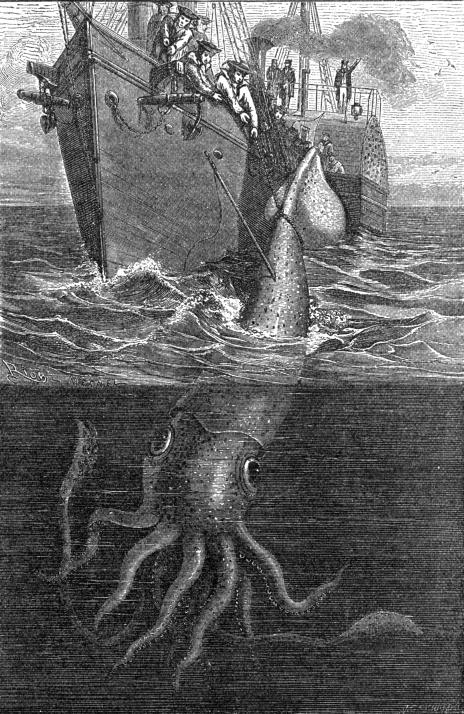
The illustration is worth comparing directly with Montfort’s print. Both place a large cephalopod beside a vessel, but the relationship has reversed. Here the people lean over the rail and the animal hangs beneath their equipment. The cutaway view below the surface lets the reader see more than anyone standing on the deck could have seen at once. It is an explanatory image, not an instantaneous visual record.
The episode illustrates both progress and limitation. A reported encounter accompanied by a recovered fragment offers something different from an inherited tale, but the failure to retain the whole animal restricts what can be established from it. The drawing should not be used as a scale diagram of a measured specimen.
Newfoundland And Moses Harvey, 1873
A more tangible episode followed in Newfoundland. In 1873, the clergyman and amateur naturalist Moses Harvey acquired a giant squid caught by local fishermen. He arranged its head and appendages over a sponge bath and had them photographed. The specimen entered a network of scientific investigation associated with the American zoologist Addison Emery Verrill. The Smithsonian recounts Harvey’s role in bringing these animals to wider scientific attention. Read the Smithsonian’s giant-squid history.
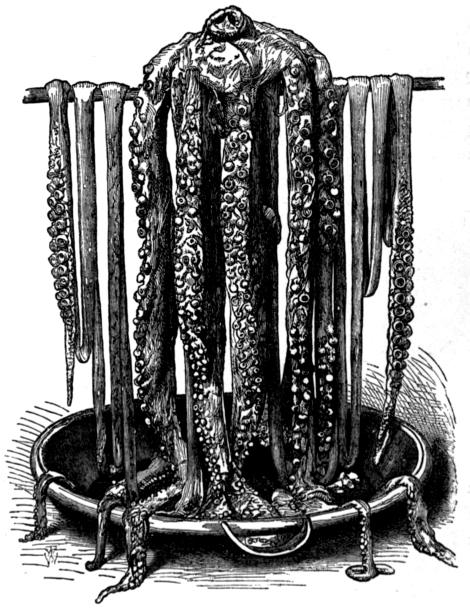
The domestic setting is striking. The bath and supporting rail provide an ordinary frame of reference for an extraordinary animal. The arms hang down rather than coil around a mast; the arrangement invites inspection rather than escape. Seen alongside the two shop prints, this image changes the question from what a monster might do to what a specimen can demonstrate.
Such remains could support anatomical comparison and scientific description. They did not retrospectively verify every older report. Evidence for a very large squid is evidence for that animal; it cannot, without further support, establish an island-sized body, a ship-destroying grip or a whirlpool caused by a monster’s descent.
The Kraken In Victorian Print, 1887

Explore This Print: Unframed · Framed And Mounted
The qualification in the original caption is essential. This is the kraken “as seen by the eye of imagination”, not an illustration offered as a witnessed incident. Its provenance and caption are recorded with the historical image.
Dark arms occupy the foreground, the ship heels above them and lightning cuts through the sky. Where Montfort gives the creature a confrontational, almost diagrammatic presence, the 1887 image surrounds it with weather and darkness. The viewer is placed close to the imagined struggle, with little sense of a safe distance.
Gibson’s accompanying discussion sought natural explanations for the tradition, connecting descriptions of arms and discoloured water with cephalopods. His confidence should itself be read historically: identifying plausible animal features does not settle the origin of every story. The surviving extract shows explanation and fascination sharing the same pages.
Together, the two prints offer distinct encounters with the maritime imagination. They are valuable historical images because they preserve ways of picturing the unknown. Their force does not depend on treating their ship attacks as documentary fact.
The Animal Behind The Legend
The giant squid, Architeuthis dux, provides a credible natural counterpart to parts of the kraken tradition. It has eight arms and two longer feeding tentacles, a very different anatomy from the broadly octopus-like creatures in the two engravings. Large females can reach about 13 metres in total length, including the long tentacles. That is an impressive animal, but total length should not be confused with the length of a solid body capable of enclosing a ship. The Natural History Museum discusses the biological basis of the legend.
Encounters with unusual or damaged animals may help explain some monster reports. They cannot be assigned as the explanation for every account simply because the resemblance is tempting. The medieval feeding creature, Pontoppidan’s rising fishing ground and Montfort’s ship-gripping octopus are not interchangeable descriptions of one demonstrated species.
The most compelling history of the kraken preserves that complexity. It follows how reports were collected, how pictures made them vivid, and how physical remains changed the questions naturalists could answer. The result is a maritime story in which the imagination remains powerful even when its claims are examined closely.
Sources And Further Reading
- McCarthy, Sebo and Firth, “Parallels For Cetacean Trap Feeding And Tread-Water Feeding In The Historical Record”, Marine Mammal Science (2023). Medieval texts and a proposed whale-feeding interpretation.
- Henry Lee, Sea Monsters Unmasked (1883). A historical source containing earlier accounts and the two supplementary illustrations; its zoological conclusions should not all be treated as current science.
- John Gibson, extract from Monsters of the Sea: Legendary and Authentic (1887), reproduced by Anima Loci.
- Biodiversity Heritage Library, “Release The Kraken!”. Bibliographic context and links to digitised historical works.
- Smithsonian Ocean, “Giant Squid”. Specimens, scientific investigation and natural history.
- Natural History Museum, “Sea Monsters: The Inspiration For Serpents, Mermaids And The Kraken”. Modern zoological context.