With three tiers of guns and a towering spread of canvas, HMS Queen embodied the confidence of the Victorian Royal Navy. Yet her career also exposed the limits of the sailing battleship: a vessel built to command the sea would eventually be rebuilt to meet the demands of steam.
Launched at Portsmouth on 15 May 1839, Queen belonged to the generation of great wooden warships that carried the traditions of the age of Nelson into a rapidly changing world. She was a flagship, a setting for royal ceremony and a participant in the Crimean War. Her story brings together naval architecture, imperial presence and technological change.
Three works in the Historical Maritime print collection offer distinct ways into that story. Robert Strickland Thomas shows the ship under sail and receiving Queen Victoria at Portsmouth; a view attributed to a follower of Anton Schranz places her in Malta’s Grand Harbour. Together, the pictures reveal a warship as a fighting vessel, a public spectacle and part of the everyday landscape of a naval port.
HMS Queen At A Glance
- Launched: 15 May 1839, Portsmouth Dockyard.
- Type: 110-gun first-rate ship of the line, originally built with three gun decks.
- Designer: Sir William Symonds.
- Earlier Name: Royal Frederick, before launch.
- Service: Mediterranean flagship and Crimean War operations.
- Rebuilt: Converted to screw propulsion and reduced to two decks and 86 guns in 1858–1859.
- Final Fate: Sold for breaking in 1871.
Building A First Rate For A New Reign
The term “first rate” denoted the highest category within the Royal Navy’s traditional rating system. A ship of the line was intended to take her place in a fleet’s battle formation, bringing batteries of heavy guns to bear along her sides. In Queen, those batteries occupied three principal decks, giving the hull the imposing height that dominates all three paintings.
Her keel was laid at Portsmouth in 1833 under the name Royal Frederick. Designed by Sir William Symonds, she measured about 204 feet along the gun deck and 60 feet across the beam. An important structural feature was the use of iron diagonal riders in place of bulkier wooden reinforcement. The National Maritime Museum’s contemporary model record explains how this arrangement helped strengthen the hull while releasing internal space.
The surviving 1833 lines plan offers a useful counterpart to the paintings. Its measured curves describe the ship as a design problem: a large hull had to carry weapons, stores and rigging while remaining manageable at sea. The paintings turn the outcome of those calculations into an image of authority.
Even the stern combined function with representation. A contemporary stern model at Greenwich records glazed and false windows, galleries, carved royal arms and the ship’s name. Such decoration made a naval vessel recognisable, but also announced the institution she represented. Queen was designed to be seen as well as to fight.
Queen Under Sail: Power In Motion

Thomas presents Queen almost broadside to the viewer, with her bow pointing to the right. The pale sails fill much of the sky above the black-and-white hull. A second large vessel stands farther back, while small boats occupy the foreground and the harbour’s buildings form a low band along the horizon.
The contrast of scale is deliberate and effective. From the level of the small boats, the warship seems monumental. Yet the canvas prevents her from appearing immovable: the rounded surfaces suggest wind, and the arrangement of the sails turns a heavy wooden structure into a vessel capable of purposeful movement. The orderly rows of gunports establish military strength; the rig gives that strength mobility.
The record for this image identifies the subject as Queen leaving Malta as Vice-Admiral Sir Edward Owen’s flagship. This is an image of command expressed through a single ship. The surrounding craft give her a setting, but the composition makes clear where the viewer’s attention should rest.
The Work Behind The Sails
The spread of canvas also invites a practical question: how was it controlled? Sails had to be set, trimmed and reduced; yards had to be braced; orders had to pass between officers and the men working on deck and aloft. The apparent unity of the painted ship conceals many separate tasks. A change in wind demanded coordinated action across the whole rig.
Looking from the taut lines of the hull to the curves of the sails brings out that relationship. The guns depended on the ship reaching a useful position, while the ship’s position depended on wind and seamanship. Thomas’s portrait makes these systems appear harmonious. Its calm, luminous atmosphere celebrates a vessel under control rather than showing the strain involved in keeping her that way.
Grand Harbour: The Flagship At Anchor

The Grand Harbour view changes the emphasis. Here the sails are furled, revealing a fine network of rigging above the sharply defined hull. The water is comparatively still. Fortifications and tightly grouped buildings frame the anchorage, while small boats introduce a human scale close to the surface.
With the canvas gathered away, the ship becomes easier to read as a structure. The three rows of gunports form long horizontal lines; the masts draw the eye upwards; the bowsprit extends the composition towards the harbour entrance. The vessel’s strength is conveyed through proportion and precision rather than movement. Her broadside is almost an architectural elevation set within a coastal townscape.
A flagship at anchor was still a working ship. Boats provided the connection with the shore and other vessels, carrying people, supplies and messages. The foreground craft in this image make that dependence visible. Even the largest warship belonged to a wider maritime community: her independence at sea relied on services and labour supplied in port.
The connection with command is supported by surviving Admiralty drawings. Greenwich holds a profile showing Queen fitted as a flagship in March 1842, together with a quarterdeck and forecastle plan from the same date. These records provide a practical context for the ship’s imposing presence in the harbour scene.
A Harbour View With A Careful Attribution
The attribution “follower of Anton Schranz” matters. It associates the work with a painter’s artistic tradition without identifying that painter as its confirmed maker. The published artwork record describes the original as pen, ink and watercolour heightened with white. Its crisp outlines and delicate colouring suit a view in which the identity of the ship and the character of the harbour are equally important.
Seen beside Thomas’s sailing portrait, this print offers a quieter account of naval presence. The flagship is impressive, but she shares the image with the town and its waterborne traffic. Sea power appears here as a continuing occupation of space, sustained by the relationship between a vessel and her base.
Queen Victoria’s Visit: Portsmouth, 1 March 1842

The third print records a specific occasion. On 1 March 1842, Queen Victoria and Prince Albert visited the fleet at Spithead, travelling aboard the steamer Black Eagle before boarding Queen. The National Maritime Museum’s catalogue identifies the painting as a work signed and dated by Thomas in 1842.
The weather was foggy and wet, a circumstance reflected in the heavy sky and dark water. Sailors manned the yards, ships fired salutes, and flags marked the royal and naval presence. The museum identifies Black Eagle immediately in front of Queen. Small boats gathered around the larger vessels as people watched the event.
Thomas turns those elements into a carefully staged spectacle. The central ship is illuminated against a subdued background; smoke and cloud soften the surrounding vessels; the foreground boats lead the eye towards the royal party. Compared with the open brightness of the Malta portrait, the atmosphere is compressed and dramatic. The same ship has become the centre of a public occasion.
The figures high on the yards are particularly striking. At a distance they appear as tiny marks, yet they change our understanding of the masts from pieces of equipment into occupied spaces. Ceremony makes the crew visible. The print records royal attention, but its visual effect depends equally on the sailors whose ordered presence gives the ship life.
The Crimean War: Beyond The Ceremonial Image
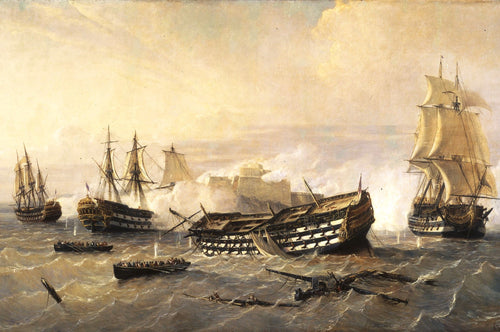
The serene harbour scenes belong beside a more demanding part of Queen’s career. During the Crimean War she operated in the Black Sea and took part in the bombardment of Sevastopol on 17 October 1854. Christie’s historical account of the ship records that she caught fire three times and eventually withdrew from the action.
That episode gives the paintings a different resonance. The tall hull and elaborate rig that made a first rate so impressive were also vulnerable. In battle, damage could affect movement, firepower and the ability to keep the ship afloat at the same time. A warship’s size did not remove the danger faced by the people inside her.
None of the three prints depicts that bombardment. Their value lies instead in showing the vessel before the violence is introduced: an identifiable ship with a recognisable shape, a place within a fleet and a public reputation. Knowing her later service makes those composed images more consequential. The ship admired in port was also expected to withstand enemy fire.
From Sail To Steam
In 1858–1859, Queen underwent a major reconstruction at Sheerness. A steam engine and screw propeller were installed, her three-deck arrangement was reduced to two, and her armament became 86 guns. The same historical catalogue account records her undocking on 5 April 1859 and subsequent Mediterranean service.
This was more than an alteration to the ship’s silhouette. Mechanical propulsion gave commanders another means of controlling movement when wind was unhelpful. At the same time, machinery introduced new requirements for fuel, maintenance and internal space. The rebuilt vessel embodied the overlap between established seamanship and a different technological system.
Her conversion also sets a limit on how these prints should be read. They preserve the appearance and associations of Queen as a three-decker. They are not illustrations of her later configuration. The distinction allows us to appreciate what the pictures retain: the visual character of a sailing flagship whose working life continued after her original form had changed.
Queen was sold for breaking in 1871. Her surviving portraits give permanence to something that naval service itself could not preserve. Thomas’s spread of canvas, the delicate harbour view and the crowded royal occasion each capture a different relationship between the ship and the people around her. Together, they present a richer history than a sequence of dimensions and dates: power under sail, presence in port, and a vessel made visible to the nation she served.
Explore The Three HMS Queen Prints
Each artwork is available in the Historical Maritime collection as an unframed fine art print or a framed and mounted print. Use the links below to explore the individual scenes.
-
HMS Queen Under Sail — Robert Strickland Thomas
Unframed Print · Framed And Mounted Print -
HMS Queen Lying In Grand Harbour — Follower Of Anton Schranz
Unframed Print · Framed And Mounted Print -
Queen Victoria’s Visit To HMS Queen — Robert Strickland Thomas
Unframed Print · Framed And Mounted Print
Sources And Artwork Notes
The history above draws on Royal Museums Greenwich’s ship models, Admiralty plans and painting catalogue, the Royal Naval Association’s launch anniversary account, and the historical catalogue entry linked in the sections on the Crimean War and steam conversion. Descriptions of composition are based on the three reproduced artworks.
A Note On Dates: The sailing portrait is offered in our collection with “1845” in its product title. The image record linked above transcribes the signature as “1842”. This article therefore identifies the scene and artist without presenting 1845 as a securely established painting date. The Grand Harbour view retains the attribution “follower of Anton Schranz”; its maker is not identified as Schranz himself.