On 5 November 1863, New Yorkers gave a ball for Russian naval officers at the Academy of Music. The occasion was grand enough to furnish an illustrated record of the dancing. Across the Atlantic, officers of the same navy were already asking the American minister in St Petersburg to convey their thanks. Few guests in the ballroom could have traced the evening’s festivities back to their point of departure in an uprising in Poland and a decision about where Russian warships should spend the winter.
Two squadrons came to the United States that autumn. Rear Admiral Stepan Lesovsky brought the Atlantic squadron to New York. Rear Admiral Andrei Popov gathered his Pacific ships at San Francisco. Their presence gave the Union a conspicuous friend at a difficult hour. The reason they sailed, however, is clearest in the orders issued before anybody in New York thought of holding a ball.
The Risk of Staying at Kronstadt
In January 1863 an insurrection broke out in Russian-ruled Poland. Britain, France and Austria pressed the imperial government over its handling of the crisis. The exchanges remained diplomatic, but naval preparations had to allow for their failure. A captain could wait for a declaration of war. A squadron in the Baltic could wait too long. Winter ice might hold ships at their bases, and a hostile navy commanding the exits could keep them there after the thaw.
The Russian naval minister, Nikolai Krabbe, had wooden warships with extensive sail plans and auxiliary steam engines at his disposal. Against the Royal Navy their best prospect lay on the open ocean. A frigate that had little hope of breaking a blockade might compel an opponent to protect merchant shipping across a wide area, provided she got to sea before the blockade began. Sail mattered here. It allowed a cruiser to make a long passage without consuming the coal she might later need to pursue a vessel or enter a harbour.
Alexander II approved instructions for Lesovsky in July. They named New York as his destination and allowed him, in consultation with the Russian representative in Washington, to distribute his vessels among American ports if necessary. A European declaration of war would give him discretion to attack enemy commerce. Until then his duties were to preserve his ships and keep in touch. Which flag a merchantman flew, and whether a declaration had actually reached him, would determine what a Russian captain was entitled to do when he met her.

A Squadron Under Canvas
The Atlantic force that assembled in American waters comprised six vessels. The screw frigates Alexander Nevsky, Peresvet and Osliabia were joined by the corvettes Vityaz and Variag and the clipper Almaz. They came by different routes. Osliabia, for example, had been in Greek waters when ordered west. The squadron that New Yorkers saw at anchor had first to be brought together from widely separated stations.
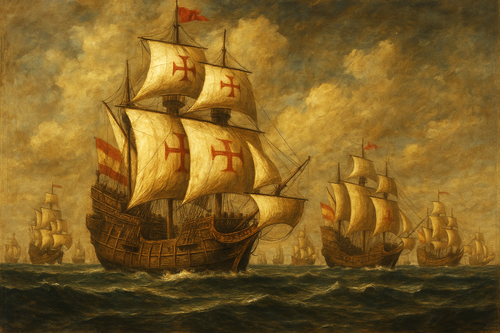
Alexey Bogolyubov’s Russian Squadron on Its Way to America, reproduced at the head of this article, makes something of that distance. The nearest ship occupies enough of the canvas for the eye to follow her yards and the lift of her bow. Farther away, another set of sails dwindles almost to the colour of the sky. Seen at the scale of the leading ship, the swell is steep. Seen across the whole squadron, the same sea makes it surprisingly easy to lose a vessel against the horizon. The picture rewards a second look at the faint ships after the bright canvas of the first has caught the eye. View the complete Bogolyubov print.

Why San Francisco?
Popov faced a different chart. His Pacific squadron was already far from the Baltic, but a remote Russian anchorage offered little advantage if he could neither provision the crews nor undertake repairs. In an August letter to the naval minister he explained his choice of San Francisco in those terms. A ship could lie in sheltered water and still be unfit for an ocean passage. The Californian port offered access to the supplies and labour that made a long deployment possible.

One vessel failed to reach it. The Russian corvette Novik was wrecked near Point Reyes on the approach to San Francisco. The headland lies north of the Golden Gate, where an error in the estimated distance offshore could put a ship among the breakers before her officers recognised land. The lighthouse at Point Reyes would first shine in 1870. In the history of the visit, the Pacific squadron is usually represented by the ships that entered the bay. The loss of Novik belongs to the same voyage. National Park Service maritime survey.
What the Americans Saw
The visitors arrived in a country whose own war had given foreign warships a particular significance. The Union victories at Gettysburg and Vicksburg were only a few months old. Confederate cruisers were still taking Northern merchant shipping at sea. The sight of Russian ensigns in a Northern harbour offered a piece of diplomatic news that could be understood from the waterfront. The ships were there for anyone to see. Their instructions remained in Russian hands.
A photograph identifies a group of sailors from Variag, men whose names seldom occur in the diplomatic correspondence. And in a dispatch of 8 November, Cassius M. Clay, the United States minister in St Petersburg, described a visit from Major General Greig. Russian naval officers wished to return the hospitality if American warships should call at Kronstadt. Clay replied that Americans admired the emperor for emancipating the serfs and valued his friendship towards the Union. That was Clay’s reading of American feeling, offered to a Russian officer and then reported home to Washington. It is a revealing piece of diplomacy in its own right. Clay’s dispatch.

By December, Lesovsky and part of his squadron had entered the Chesapeake and ascended the Potomac. Secretary of State William H. Seward received the officers on 5 December. Two days later members of the cabinet visited the Russian flagship, and that evening Seward entertained the visitors at his house. His report even accounts for an absence easily misread from a distance. Illness had kept Lincoln from granting a formal audience. Here the record is unusually precise about who met whom, where they dined and whose greetings Seward conveyed. It records no military undertaking. Seward’s dispatch of 8 December.
The War That Never Came
The European crisis subsided, and the Russians returned home in 1864. The anticipated orders to begin a commerce war never came. In later retellings, the warmth of the American welcome helped sustain a more dramatic account in which the emperor had dispatched his fleet to fight for Lincoln. In 1915 the historian Frank Golder examined the episode against Russian archival evidence. A useful distinction emerges from reading those papers alongside the American dispatches. The admirals’ orders explain why their ships went to sea. Clay and Seward explain why Americans attached such importance to where they dropped anchor. Both sets of papers are needed to understand the visit.
Bogolyubov chose the passage itself as his subject. New York is still beyond the edge of the painting. For the officers on those decks the immediate achievement was a practical one. When news next reached them from Europe, their ships would already be at sea or within reach of an open ocean.
Sources and Further Reading
- Naval Historical Foundation, The Russian Navy Visits the United States. Includes translations of Lesovsky’s instructions and Popov’s explanation of his choice of port.
- US Department of State, diplomatic papers for 1866. The account of a reciprocal American visit names the vessels of Lesovsky’s squadron. English-language records vary in their spellings of the ships and officers.
- Frank A. Golder, “The Russian Fleet and the Civil War,” American Historical Review (1915). A foundational study of the naval orders. For the later debate over American interpretations, see “The Russian Fleet and the American Civil War: Another View”.