
Mauritius, August 1810. Two frigates burned on the reef. The French took the other two. The captains’ dispatches and a French battle painting tell the story from different shores.
Captain Samuel Pym had already run his frigate aground once when, on the afternoon of 23 August 1810, he ordered four British warships into Grand Port. He had good reason to believe the worst of the passage lay behind him. His captains and pilot had met aboard HMS Sirius. The French ships were in sight. Each British captain knew which opponent he was to engage. Pym later reported that he had been assured they were “past all Danger and could run direct for the Enemy’s Line.” Within hours, two of his frigates were on the reef. Pym’s dispatch, published in the London Gazette
All four frigates were lost. Two British crews destroyed their own ships. A third ship fell to the French after a close action in which her captain and senior officers were wounded. The fourth remained afloat and under British command for days after the decisive fighting. In Pierre-Julien Gilbert’s painting, their several fates can be taken in at a glance. To understand the defeat, it helps to separate them again. Pierre-Julien Gilbert’s Battle of Grand Port
An island fort and a passage through the reef
Grand Port lies on the south-eastern coast of Mauritius, then the French colony of Île de France. To an East India Company captain, the danger posed by the island was quite practical. French cruisers could put to sea, intercept merchant vessels on the routes to India and bring them into a defended harbour. In August 1810 two such captures, the East Indiamen Ceylon and Windham, brought the opposing squadrons together. These ships had been sailing from the Cape towards Madras with men of the 24th Regiment aboard. Their loss concerned soldiers and passengers as well as merchants and underwriters. Contemporary British dispatches

The British had taken Île de la Passe, the fortified islet commanding the entrance to Grand Port. When Guy-Victor Duperré’s French squadron approached on 20 August, that success appeared to offer the British a remarkable opportunity. Captain Nesbit Willoughby had HMS Nereide at the entrance. If the approaching squadron could be divided as it passed the fort, a single frigate and a shore battery might accomplish what would otherwise require a much larger force.
Duperré’s account, preserved in William James’s naval history, gives the French side of the decision. When Duperré saw British colours at the fort and fire directed at the corvette Victor, he signalled his ships to haul off. But Minerve and the captured Ceylon had already entered the channel and could no longer turn back. The passage had begun to dictate the action before Pym arrived. Duperré went into the harbour with his ships. Windham, which remained outside, was subsequently recovered by Sirius. The distinction mattered. Ceylon would take part in the coming battle on the French side. William James, The Naval History of Great Britain, volume V
What Pym expected his four ships to do
Inside Grand Port, Duperré arranged his vessels in a curve close to shore, with shoal water protecting part of the approach. The French had also been preparing batteries ashore. Delay carried a cost for Pym. Every hour gave Duperré time to bring more men aboard, improve his position and turn a captured merchant ship into another gun platform. Pym’s first attempt to close on 22 August ended when Sirius grounded at the edge of the inner passage. She was freed the following morning. That first grounding was both a warning and, in a perverse way, a reassurance. They had found one obstruction and got past it. Pym’s account of the approach
When Iphigenia and Magicienne joined on 23 August, Pym assigned stations. His own Sirius would lie alongside Duperré’s Bellone. Willoughby would take Nereide into the interval between Bellone and Victor. Henry Lambert in Iphigenia was to engage Minerve. Lucius Curtis in Magicienne would go in between Minerve and the East Indiaman. It was a plan for mutual support. Each French ship, occupied by an opponent nearby, would have less freedom to concentrate its guns elsewhere. The British order of attack
The weakness of the plan was the order in which its risks came due. Every British ship had to make a difficult approach before any captain could count on receiving the support he had been promised.
Four crews in the harbour
Magicienne · 24 August
By the time Captain Lucius Curtis ordered his men off Magicienne, there were between eight and nine feet of water in the hold. The reef held the ship at an angle that left most of her guns pointing wide of the French. Her officers and men crossed to Iphigenia. Curtis and Lieutenant Robert Smith set their frigate alight that evening. She exploded at about eleven with her colours still flying.
One of her boats had a further part to play. Two evenings later Lieutenant Robert Wauchope took Magicienne’s barge out from the British position in an attempt to reach Bourbon, today’s Réunion. A ship could disappear in a few hours and her boats and men still figure in the next day’s orders.
Sirius · 25 August
Pym’s men spent another night beside their grounded ship. Before leaving her, they passed shot and cartridges to Iphigenia. Lambert had recovered two of her anchors as well. These mattered as much as ammunition. To move through the shoals, his men had to carry an anchor ahead in a boat and haul their frigate towards it on a cable.
Most of Pym’s company went aboard Lambert’s frigate. Lieutenant Watling and nine men took a different course. That evening they left in the pinnace carrying Pym’s dispatches. A French brig gave chase. The boat pulled close inshore among the breakers and escaped, reaching Bourbon on 27 August. News of the defeat had got out before the last British frigate surrendered. William James on the evacuation and the passage to Bourbon, pp. 163–65
Nereide · Aboard the captured ship
French lieutenant Roussin boarded on 24 August. He found men dead and dying on deck. His party disabled the guns and took off twenty French prisoners. For those twenty men, the arrival of a boat from the French squadron meant release. For the British survivors beside them, it marked the beginning of captivity.
Pym’s early dispatch gave the impression that every man aboard had been hit. He was reporting from outside the ship. Royal Museums Greenwich records 92 dead and 52 uninjured in a company of 281. The British list of wounded officers preserves details a total cannot convey. First Lieutenant John Burns was mortally wounded. William Lesby, the master, suffered a splinter injury to his side and later burned his hand putting out a fire in the rigging. Willoughby himself was too badly wounded to travel with the other captains and remained at Grand Port. Roussin’s report and the British casualty list · Royal Museums Greenwich collection record
Iphigenia · 28 August and the months that followed
Lambert had brought his frigate back towards Île de la Passe with survivors from two other ships. The withdrawal took days. An anchor dragged overnight and some of the distance gained by hauling on the cable had to be covered again. By the time French reinforcements arrived, Lambert had men enough to work both sides of the ship, little ammunition for a sustained action, and a dwindling supply of fresh water for the sailors and the garrison.
On 28 August the French offered to send the crew and garrison to the Cape or England within a month. The men would give their word to stay out of the fighting until formally exchanged. Lambert surrendered. James records that Pym, Curtis and Lambert and their men were taken to Port Louis. Prisoners covered by the terms were still on Mauritius when the British took the island in December. For these sailors the five days of fighting and withdrawal were followed by three months of waiting. The terms and the fate of the prisoners, pp. 167–70
Looking at Gilbert’s painting
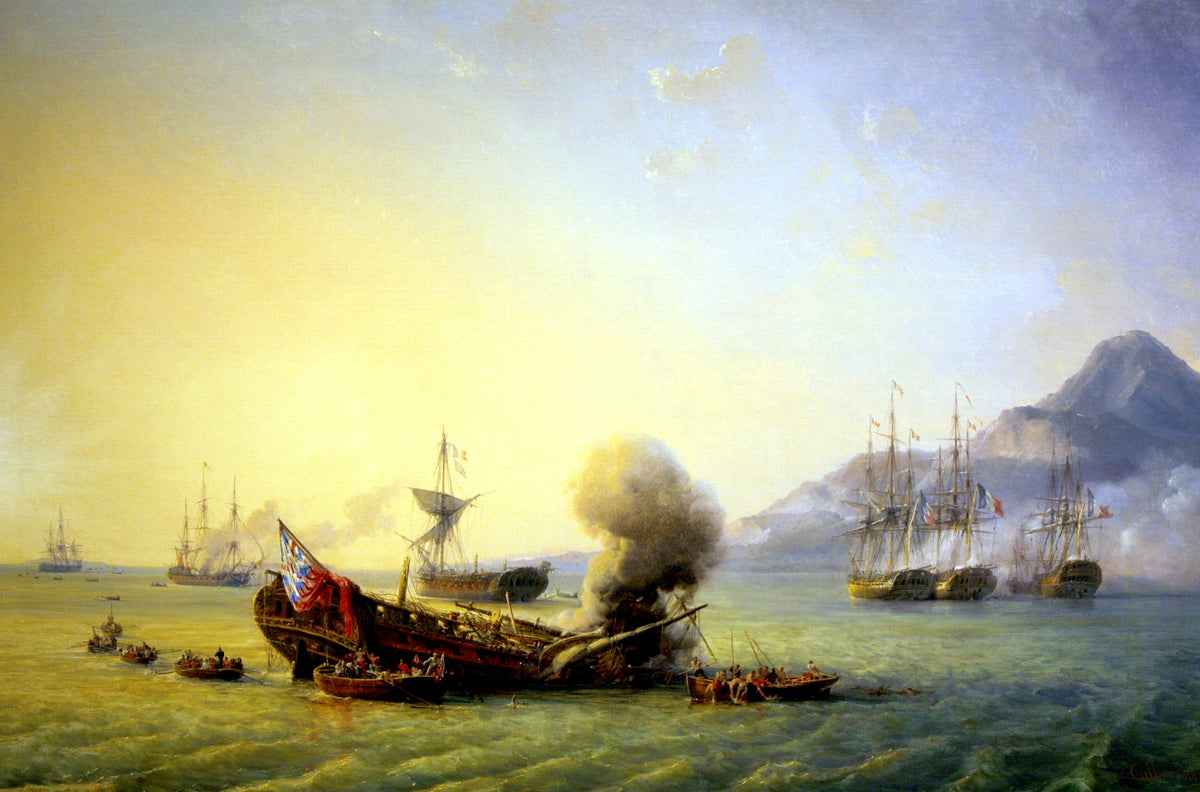
Begin with the masts. The rigging of the French ships draws a web of upright lines against the sky. The dismasted Nereide breaks that pattern. Even from the far side of a gallery, a viewer can recognise a ship that has lost the means to sail. Roussin’s report supplies the view Gilbert’s distant spectator cannot have. Across that low rail lay wounded British sailors and French prisoners waiting to be taken off.
Farther back, smoke makes the destruction visible but the ships harder to identify. In its entry for an engraving after Gilbert, Royal Museums Greenwich tentatively identifies the burning vessel as Sirius and the wreck below as Magicienne. The records distinguish the two fires more securely. Curtis burned his frigate on the evening of the 24th. Pym burned his the following morning. By then, men from both crews had made their way aboard a third ship. Examine the Greenwich engraving
The catalogue of the Paris Salon of 1827 describes Gilbert’s Grand Port subject as the end of the combat and dates it to 25 August. The Versailles engraving carries 24 August in its title. On either date Iphigenia was still British. Pym’s dispatch of the 26th entrusted Lambert with the defence of the island. Read as a sign of the final surrender, the distant flag belongs to an outcome the men hauling on the cable could not yet know. Gilbert could look back across the entire engagement. Each captain had seen only part of it. Paris Salon catalogue, entry 455 · Pym’s dispatch of 26 August
Why the victory did not save Mauritius
The most telling disagreement in the British record appears in the dispatches themselves. Pym stressed the assurances he received from the pilot. His superior attributed the loss to Pym’s failure to appreciate the difficulties of the navigation. Both men knew that ships had grounded. They differed over where responsibility lay when a commander accepted a pilot’s judgment. The chart could identify a passage; the pilot could advise on it. The order committing four ships to the attack was Pym’s. British dispatches published together in December 1810
Three months later, the British returned to Mauritius with an expedition carrying British and Indian troops. On 29 November they landed in the north of the island, far from the reef at Grand Port, and advanced towards Port Louis by land. The French capitulated on 3 December. Duperré and Bouvet had defended one anchorage with remarkable success. A squadron stationed there could do little to prevent an army coming ashore on another coast. National Army Museum, The Taking of the Isle of France · Mauritian account of the landing · National Archives of Mauritius

That is the limit, and the measure, of the victory Gilbert painted. In August the British entered by the passage the French were best placed to defend. In November they chose their own landing ground. The first decision put four frigates within reach of Duperré’s guns. The second put the capital within reach of an army.


